brishti nemeche aaj
G-----------Em------C-------D
brishti nemeche aaj akash venge
G-----------Em------C-------D
haatchi aami metho pothe
G-----------Em------C-------D
moner canvas-e vashche tomar chhobi
G-----------Em------C-------D
bohudin tomai dekhi na je.
C--G--------D-----Em
tomai niye koto shopno
G-----D-----Em---D
aaj kothao harai
C--G--------D-----Em
purono gaan-tar shur
G-----D-----Em---C
aaj more kaadai.
G--------D-------------Em-----------C
tumi to diyechile more krishnochura ful
G--------D-------------Em-----------C
ami to boshechilam niye shei gan er shur
G--------D-------------Em-----------C
tumi to diyechile more krishnochura ful
G-------------C----------D-----Em---G
chole gecho kothai amai fele bohudur.
shada kalo ei jiboner majhe
rongin chile tumi shudhu
tomai niye lekha koto kobitai
diyechilam koto shur.
aaj amar haat-er muthoi
nei je tomar haat
bhorer alo futbe kokhon
vebechi koto raat.
juddho sheshe ghore fire
dekhi nei tumi je paashe
bhebechilam tumi thakbe dariye
krishnochura ful haate
tobe ki juddher belai
tomai harate
epitaph-er lekha gulo
pori jhapsha chokhe
ami to diyechilam tomai krishnochura ful
tumi to geyechile shei notun gan er shur
ami to diyechilam tomai krishnochura ful
tobe keno gelam ami chole tomai fele... bohudur.
Showing posts with label cords of guitar. Show all posts
Showing posts with label cords of guitar. Show all posts
Monday, 14 June 2010

Thursday, 3 June 2010
Ascii Art of guitar
Ascii Art of guitar
LEtz RoKzZz...!!! +---+ ................ ..........|/|/|/|/| ..........(^O.O^) ..........(...(_)...) ............\..--../__ ........./¯¯Y¯¯\. \ \ .........|....|.......\ ..\ .........|._.\_.....| \_.\ ..........\__\......|...\..\ ......(¯¯¯\...\_|/¯¯\__\_________oooooo ........)===ºººº====0000=========) ......(_...___/¯¯¯\__/ ........./..../........\... \ ....__./._/.............\._.\__.. ...(____ /............ .(______) _+880_____________________________ _++88_____________________________ _++88_____________________________ __+880_________________________++_ __+888________________________++88_ __++880______________________+|+88__ __++888_____+++88__________+++8__ __++8888__+++8880++88____+++88___ __+++8888+++8880++8888__++888____ ___++888++8888+++888888++888_____ ___++88++8888++8888888++888______ ___++++++888888888888888888______ ____++++++88888888888888888______ ____++++++++000888888888888______ _____+++++++000088888888888______ ______+++++++00088888888888______ _______+++++++088888888888_______ _______+++++++088888888888_______ ________+++++++8888888888________ ________+++++++0088888888________ ________++++++0088888888_________ ________+++++0008888888__________ ??? ??? ?? |?V ?||?? ?? ??) ________________________________
Wednesday, 2 June 2010
Choosing A Guitar
Apprentice Guitarists Start Here!!!
In her article last issue Anne Walker stated that learning to play the harp is easier than learning to play guitar. Now, Anne is a very good friend, but that is fighting talk! Learning to play simple accompaniments is *not* difficult and can be lots of fun. Of course attaining the standard of, say, Julian Bream or Eric Clapton does take practice.
Choosing your Instrument:
To state the obvious, if you want to play guitar, you need a guitar to play on. However there are a number of different types of guitar and the type you get depends upon what you want to do with it. And the answer "Learn to play the thing, of course!" just isn't good enough. The main types of guitar are as follows:
Classical (or Spanish) guitar
Flamenco guitar
Accoustic (or Folk) guitar
Electric guitar
Semi-accoustic guitar
12-string guitar (*This can come in accoustic, semi-accoustic and full electric versions*)
Bass guitar (*Accoustic and electric*)
If you want to play Baroque concertos, you would not buy a bass guitar. Similarly if you want to play Heavy Metal, you would not buy a Flamenco guitar. But apart from those obvious examples, how does a complete beginner know which sort of instrument to get? If you are planning to take proper lessons, then your teacher will give you very good advice. If you are teaching yourself with the help of a book, then read what is has to say on choosing your instrument very carefully. The following is a general guide.
Classical or Spanish Guitar
The instrument traditionally used for playing "classical" music comes originally from Spain. It is made of wood with a large, hollow sound-box with a shape reminiscient of the female torso, which is probably why so many male guitarists give their instruments female names. (Both my Spanish guitars have male names, as indeed do all my instruments, which allows me to be rude about them!) The long fretboard is made of solid wood, and the machine heads are geared to facilitate fine tuning. Historically the instrument was strung with gut strings. Nowadays nylon strings are used - NEVER, NEVER, NEVER put metal strings on a classical guitar! - which gives a sweet, gentle, slightly muted sound. This instrument is ideal for any melodic work but particularly suited to classical music.
Cons: The fretboard is wider than on an accoustic guitar, which could cause problems for people with small hands and/or short fingers; nylon strings "learn" a tuning and don't "like" change, which makes experimenting with different tunings difficult and/or expensive; heavy strumming styles (e.g. heavy rock) doesn't sound quite right when played on nylon strings.
Flamenco Guitar
The main difference between this and a classical guitar is that the fretboard is even wider. Apart from that, the two guitar types are pretty much the same.1)
Accoustic or Folk Guitar
This is similar in looks to the classical. The main differences are that the fretboard is narrower with extra
strengthening to cope with greater tension, the sound-box is sometimes extra large (e.g. "Jumbo" guitars), and the strings are made of steel. The sound these make is thinner and more "brittle" and on a very cheap instrument can sound tinny. However it is very popular with folk musicians on both sides of the Atlantic who have little problem playing complex finger-picking styles on them. If you want to play rhythms, do a lot of heavy strumming, take your first steps in rock, use a variety of tunings or if you want to play blues and its variants, e.g. slide or "bottleneck" guitar, you should give this type of guitar serious consideration.
Cons: Not suitable for playing classical music; the metal strings cut into the fingers much more than nylon strings, and you may need to wear finger picks; the sound is harsher.
Electric Guitar
An electric guitar is a guitar which needs to be plugged into an electric amplifier for any appreciable sound to be
heard. Many are completely solid and can be heavy. Always wear a comfortable shoulder strap. Some electric guitars have a thin, hollow sound-box in which the electric gadgetry is concealed. These are usually more lightweight, and there are some machines on the market which can make a variety of sounds from "classical" through to a Stratocaster. The electric guitar is used for rock, pop and performance playing in venues where amplification is needed.
Cons: Requires additional equipment such as an amplifier, leads, effects pedals etc., to use as well as a power supply; all this comes expensive; everyone hears *all* your mistakes; requires frequent servicing by an expert.
Semi-accoustic Guitar
A semi-accoustic guitar is a proper electric guitar with a large enough hollow sound-box to make enough sound so that you don't have to plug it into an amplifier when playing in a smaller area such as the living room of an ordinary house. Because the sound-box is usually metal, it does not have the depth or quality of sound of an accoustic. Please bear in mind that accoustic guitars often come with a built in pick-up to facilitate electrical amplification when necessary, so be sure you really want a semi-accoustic before parting with hard cash.
Cons: As for electric guitar; a compromise between electric and accoustic.
12-string Guitar
Guitars usually come with six strings. Twelve strings therefore double the sound - there is no need to learn new
chords! This type of guitar is particularly useful where you want loud strumming with a depth of sound, but can also be use for picking out tunes where you want twin sounds an octave apart, although this takes practice to master. It can also be used as a percussive instrument. I have seen people finger-pick accompaniments on twelve-string guitars, and indeed have done so myself, but watch out for your fingers. Warnings about metal strings operate with a vengeance with this instrument, and I have yet to see a nylon-strung version. The fretboard is extra long and many people tune their instrument down a tone to ease the tension thus lightening the action. I tune mine down so that I can sing in F and play in G!
Cons: Less flexible than a six-string guitar; it can't be used for classical music; less suited to melodic work,
unless you want a particular effect; tuning the instrument is the greatest form of masochism known to guitarists!
Bass Guitar
A bass guitar comes with four or, less usually, five strings, and occasionally with a fretless neck. The tuning
is the same as for the bottom four (or five) strings of a guitar but down an octave, and the strings are therefore
thicker and heavier. The instrument is used for laying down a bass line, and sometimes for the rhythm. In some rock bands the bassist rather than the drummer holds the band's playing together - no, I do not have anyone in particular in mind!
Cons: You are limited in what you can play; electric basses require as much equipment as any other electric guitar; the extra equipment for electric basses can be expensive; solid electric basses can be very heavy, so check the weight.
The Pernese Connection
There had to be one, didn't there? Most of the above instruments are not Pernese and would not used by members of the Harpercraft. Being very practical people the inhabitants of our favourite planet would not waste their scarce metal and energy resources on metal guitar strings and electric amplification. Their guitars would be strung with gut, and the sort of music they played would suit the sound that produced. Which is not to say that no songs would be accompanied by heavy strumming. Of course some would. And no doubt someone would lay down a heavy rhythm line on an accoustic bass with thick gut strings. If you are thinking of taking up guitar simply because your persona is an apprentice harper, (and why not? As you learn, you can pepper your stories with anecdotes based on experience as you master hurdles such as bar chords) then apart from deciding that the most suitable instrument for you is the classical or Spanish guitar, there are a few other points to bear in mind. I mentioned earlier that modern guitars usually have geared machine heads to facilitate fine tuning. This means that you can turn the pegs through quite a large angle (e.g. 1800) and only marginally alter the string's tuning. Changing the note completely will require quite a few twists. This is not true of an ungeared (or pegged) intrument, where the strings are wound directly onto the tuning pegs. A small tweak can materially alter a string's tuning. I have a pegged banjo and speak from experience! If tuning a geared 12-string guitar is the greatest form of masochism known to guitarists, trying to tune a pegged instrument is sheer torture. Pity the poor journeyman charged with teaching the new apprentices - his nerves would be raw from the cacophony of a large number of pegged instruments not quite in tune with one another.
There are, of course, no electronic tuners on Pern, and Harpers would tune their instruments by ear. Members of the Craft who have achieved significant rank are quite likely to have perfect, or near perfect pitch. Other, lesser mortals would no doubt get their pitch from pipes not too dissimilar in concept from the pitch pipes that can be bought in any music shop. On Pern such pipes are more likely to be made from reed or wood, rather than metal. Picks for heavy strumming are likely to be made from bone. The solid part of a capo is more likely to be made from wood, although a Harper should be able to play in any key. Cases would be made from canvas, leather or wood. And in the hot, dry atmosphere of Central Weyr, the wood of the instrument would have to be kept well-oiled to prevent it drying out and warping.
Of course, if you really want to play Heavy Metal (or whatever) but thought you would write a Harper persona at the same time, you must buy the instrument that is most suited to what you want to do, rather than a classical because it is the most Pernese. Once you have started learning you will get to know other guitarists who may have nylon strung instruments which you could try out, for research purposes naturally!
How Much does a Guitar Cost?
How long is a piece of string? It is still possible to buy a brand new guitar for under GBP50, though if money is
tight you might do better going for a second hand instrument. The usual advice is to spend as much as you can afford, as you are much more likely to progress with an instrument that is nice to play. I would advise trying to afford at least GBP100, and if you can afford over GBP200 the extra expense will be worth it. But be sensible - don't spend GBP2,000 simply because you have the money. You don't know at this stage how you will get on with the instrument. Also once you have set a maximum price for yourself, stick to it, don't exceed it. If the salesman suggests you try something that is "only" GBP10 more than your maximum, just say no. Finally, don't feel you have to buy the most expensive one that you can afford if you really prefer one that is cheaper. Price is just one of many considerations.
I am not familiar enough with the US market to suggest guide prices in US dollars. So why not talk to some guitar-playing filkers at the next con. They should be able to point you in the right direction.
What should I Look Out For When I Buy a Guitar?
Whether you are spending GBP30 or GBP300 you should take the same care when buying your instrument. You may want to take a friend with you for moral support. Don't feel you have to. Also, don't feel you have to buy the guitar that the salesman likes best. He (or she) is likely to be an enthusiast and will have tried out every model in stock, but what is right for the salesman is not necessarily right for you. But whatever you do, don't buy a guitar without trying it out first! How do you know what is right for you? Well, it helps if you have tried out a friend's instrument beforehand, and have learnt a few chords, but even if you haven't, if you bear in mind the following pointers, you should buy something that is reasonable to get you started. How does the guitar feel? Accoustic and classical guitars should not feel heavy. If you are buying a solid body electric guitar, how heavy does it feel hanging from a strap round your shoulders? Are your arms or shoulders going to ache after less than three minutes? You should be able to play comfortably for hours. How high are the strings from the fretboard? This is known as the action. The higher the action, that is the greater the distance between the strings and the neck, the more the strings will cut into your fingers and the greater difficulty you will have with techniques such as bar chords. It can also make the muscles in your forearms ache. Knowing two or three easy chords will help you assess how comfortable the action is for you.
The instrument should feel nice to play. When you hold down a chord, does the instrument buzz? This could be poor technique on your part, so check that you are pressing the strings down firmly in the fret, and are not touching the ridges. If the instrument still buzzes then don't buy it. Is the neck straight? This is a particularly important consideration if you are buying a second hand instrument, but should not be overlooked when buying something new. You could try looking down the neck to see if it is warped, but a complete newcomer need not recognise distortion. Another test therefore is to check the octaves. Play a string and note the sound. Count twelve frets from the head and hold down the string you have just played. Play it again, and the note should be exactly the same an octave higher. Play it few times, alternating between open and held down on the twelfth fret. The only difference between the two notes should be the pitch. Do this for each string, and if the octave is not true, then there is something wrong with the guitar. On some accoustics, the neck can be adjusted, so if the octaves are still not right to your ears after adjusting, even if the salesman says it is alright, then that is not the guitar for you.
Finally do you like the sound? If it does not make the sound you like, then don't buy it. If it sounds just right, then that is fine. Don't buy a guitar because someone else prefers the sound, if you don't.
If after all this this instrument feels nice and sounds the way you want it to sound, and it is within your budget,
and it says "Buy me!" then go ahead. Buy it. You should also buy a protective case (preferably a hard one, although at around GBP70 this can be expensive), and you may also want a capo (very useful!) and some light picks.
So now you have your guitar. Have fun! And invite me round for a session sometime, huh?
1) Since writing the above article, I have been reminded that another difference between the "classical" and the flamenco guitar is that the latter has a finger board on the sound box, to protect the finish. This is generally true, but is not absolute gospel, particularly if you are buying a secondhand instrument. In the late sixties many different types of guitars, including the steel strung acoustic, had finger boards, and the older of my two "classical" guitars, which has the narrowest neck I've ever come across on a Spanish guitar,has a fingerboard.
In her article last issue Anne Walker stated that learning to play the harp is easier than learning to play guitar. Now, Anne is a very good friend, but that is fighting talk! Learning to play simple accompaniments is *not* difficult and can be lots of fun. Of course attaining the standard of, say, Julian Bream or Eric Clapton does take practice.
Choosing your Instrument:
To state the obvious, if you want to play guitar, you need a guitar to play on. However there are a number of different types of guitar and the type you get depends upon what you want to do with it. And the answer "Learn to play the thing, of course!" just isn't good enough. The main types of guitar are as follows:
Classical (or Spanish) guitar
Flamenco guitar
Accoustic (or Folk) guitar
Electric guitar
Semi-accoustic guitar
12-string guitar (*This can come in accoustic, semi-accoustic and full electric versions*)
Bass guitar (*Accoustic and electric*)
If you want to play Baroque concertos, you would not buy a bass guitar. Similarly if you want to play Heavy Metal, you would not buy a Flamenco guitar. But apart from those obvious examples, how does a complete beginner know which sort of instrument to get? If you are planning to take proper lessons, then your teacher will give you very good advice. If you are teaching yourself with the help of a book, then read what is has to say on choosing your instrument very carefully. The following is a general guide.
Classical or Spanish Guitar
The instrument traditionally used for playing "classical" music comes originally from Spain. It is made of wood with a large, hollow sound-box with a shape reminiscient of the female torso, which is probably why so many male guitarists give their instruments female names. (Both my Spanish guitars have male names, as indeed do all my instruments, which allows me to be rude about them!) The long fretboard is made of solid wood, and the machine heads are geared to facilitate fine tuning. Historically the instrument was strung with gut strings. Nowadays nylon strings are used - NEVER, NEVER, NEVER put metal strings on a classical guitar! - which gives a sweet, gentle, slightly muted sound. This instrument is ideal for any melodic work but particularly suited to classical music.
Cons: The fretboard is wider than on an accoustic guitar, which could cause problems for people with small hands and/or short fingers; nylon strings "learn" a tuning and don't "like" change, which makes experimenting with different tunings difficult and/or expensive; heavy strumming styles (e.g. heavy rock) doesn't sound quite right when played on nylon strings.
Flamenco Guitar
The main difference between this and a classical guitar is that the fretboard is even wider. Apart from that, the two guitar types are pretty much the same.1)
Accoustic or Folk Guitar
This is similar in looks to the classical. The main differences are that the fretboard is narrower with extra
strengthening to cope with greater tension, the sound-box is sometimes extra large (e.g. "Jumbo" guitars), and the strings are made of steel. The sound these make is thinner and more "brittle" and on a very cheap instrument can sound tinny. However it is very popular with folk musicians on both sides of the Atlantic who have little problem playing complex finger-picking styles on them. If you want to play rhythms, do a lot of heavy strumming, take your first steps in rock, use a variety of tunings or if you want to play blues and its variants, e.g. slide or "bottleneck" guitar, you should give this type of guitar serious consideration.
Cons: Not suitable for playing classical music; the metal strings cut into the fingers much more than nylon strings, and you may need to wear finger picks; the sound is harsher.
Electric Guitar
An electric guitar is a guitar which needs to be plugged into an electric amplifier for any appreciable sound to be
heard. Many are completely solid and can be heavy. Always wear a comfortable shoulder strap. Some electric guitars have a thin, hollow sound-box in which the electric gadgetry is concealed. These are usually more lightweight, and there are some machines on the market which can make a variety of sounds from "classical" through to a Stratocaster. The electric guitar is used for rock, pop and performance playing in venues where amplification is needed.
Cons: Requires additional equipment such as an amplifier, leads, effects pedals etc., to use as well as a power supply; all this comes expensive; everyone hears *all* your mistakes; requires frequent servicing by an expert.
Semi-accoustic Guitar
A semi-accoustic guitar is a proper electric guitar with a large enough hollow sound-box to make enough sound so that you don't have to plug it into an amplifier when playing in a smaller area such as the living room of an ordinary house. Because the sound-box is usually metal, it does not have the depth or quality of sound of an accoustic. Please bear in mind that accoustic guitars often come with a built in pick-up to facilitate electrical amplification when necessary, so be sure you really want a semi-accoustic before parting with hard cash.
Cons: As for electric guitar; a compromise between electric and accoustic.
12-string Guitar
Guitars usually come with six strings. Twelve strings therefore double the sound - there is no need to learn new
chords! This type of guitar is particularly useful where you want loud strumming with a depth of sound, but can also be use for picking out tunes where you want twin sounds an octave apart, although this takes practice to master. It can also be used as a percussive instrument. I have seen people finger-pick accompaniments on twelve-string guitars, and indeed have done so myself, but watch out for your fingers. Warnings about metal strings operate with a vengeance with this instrument, and I have yet to see a nylon-strung version. The fretboard is extra long and many people tune their instrument down a tone to ease the tension thus lightening the action. I tune mine down so that I can sing in F and play in G!
Cons: Less flexible than a six-string guitar; it can't be used for classical music; less suited to melodic work,
unless you want a particular effect; tuning the instrument is the greatest form of masochism known to guitarists!
Bass Guitar
A bass guitar comes with four or, less usually, five strings, and occasionally with a fretless neck. The tuning
is the same as for the bottom four (or five) strings of a guitar but down an octave, and the strings are therefore
thicker and heavier. The instrument is used for laying down a bass line, and sometimes for the rhythm. In some rock bands the bassist rather than the drummer holds the band's playing together - no, I do not have anyone in particular in mind!
Cons: You are limited in what you can play; electric basses require as much equipment as any other electric guitar; the extra equipment for electric basses can be expensive; solid electric basses can be very heavy, so check the weight.
The Pernese Connection
There had to be one, didn't there? Most of the above instruments are not Pernese and would not used by members of the Harpercraft. Being very practical people the inhabitants of our favourite planet would not waste their scarce metal and energy resources on metal guitar strings and electric amplification. Their guitars would be strung with gut, and the sort of music they played would suit the sound that produced. Which is not to say that no songs would be accompanied by heavy strumming. Of course some would. And no doubt someone would lay down a heavy rhythm line on an accoustic bass with thick gut strings. If you are thinking of taking up guitar simply because your persona is an apprentice harper, (and why not? As you learn, you can pepper your stories with anecdotes based on experience as you master hurdles such as bar chords) then apart from deciding that the most suitable instrument for you is the classical or Spanish guitar, there are a few other points to bear in mind. I mentioned earlier that modern guitars usually have geared machine heads to facilitate fine tuning. This means that you can turn the pegs through quite a large angle (e.g. 1800) and only marginally alter the string's tuning. Changing the note completely will require quite a few twists. This is not true of an ungeared (or pegged) intrument, where the strings are wound directly onto the tuning pegs. A small tweak can materially alter a string's tuning. I have a pegged banjo and speak from experience! If tuning a geared 12-string guitar is the greatest form of masochism known to guitarists, trying to tune a pegged instrument is sheer torture. Pity the poor journeyman charged with teaching the new apprentices - his nerves would be raw from the cacophony of a large number of pegged instruments not quite in tune with one another.
There are, of course, no electronic tuners on Pern, and Harpers would tune their instruments by ear. Members of the Craft who have achieved significant rank are quite likely to have perfect, or near perfect pitch. Other, lesser mortals would no doubt get their pitch from pipes not too dissimilar in concept from the pitch pipes that can be bought in any music shop. On Pern such pipes are more likely to be made from reed or wood, rather than metal. Picks for heavy strumming are likely to be made from bone. The solid part of a capo is more likely to be made from wood, although a Harper should be able to play in any key. Cases would be made from canvas, leather or wood. And in the hot, dry atmosphere of Central Weyr, the wood of the instrument would have to be kept well-oiled to prevent it drying out and warping.
Of course, if you really want to play Heavy Metal (or whatever) but thought you would write a Harper persona at the same time, you must buy the instrument that is most suited to what you want to do, rather than a classical because it is the most Pernese. Once you have started learning you will get to know other guitarists who may have nylon strung instruments which you could try out, for research purposes naturally!
How Much does a Guitar Cost?
How long is a piece of string? It is still possible to buy a brand new guitar for under GBP50, though if money is
tight you might do better going for a second hand instrument. The usual advice is to spend as much as you can afford, as you are much more likely to progress with an instrument that is nice to play. I would advise trying to afford at least GBP100, and if you can afford over GBP200 the extra expense will be worth it. But be sensible - don't spend GBP2,000 simply because you have the money. You don't know at this stage how you will get on with the instrument. Also once you have set a maximum price for yourself, stick to it, don't exceed it. If the salesman suggests you try something that is "only" GBP10 more than your maximum, just say no. Finally, don't feel you have to buy the most expensive one that you can afford if you really prefer one that is cheaper. Price is just one of many considerations.
I am not familiar enough with the US market to suggest guide prices in US dollars. So why not talk to some guitar-playing filkers at the next con. They should be able to point you in the right direction.
What should I Look Out For When I Buy a Guitar?
Whether you are spending GBP30 or GBP300 you should take the same care when buying your instrument. You may want to take a friend with you for moral support. Don't feel you have to. Also, don't feel you have to buy the guitar that the salesman likes best. He (or she) is likely to be an enthusiast and will have tried out every model in stock, but what is right for the salesman is not necessarily right for you. But whatever you do, don't buy a guitar without trying it out first! How do you know what is right for you? Well, it helps if you have tried out a friend's instrument beforehand, and have learnt a few chords, but even if you haven't, if you bear in mind the following pointers, you should buy something that is reasonable to get you started. How does the guitar feel? Accoustic and classical guitars should not feel heavy. If you are buying a solid body electric guitar, how heavy does it feel hanging from a strap round your shoulders? Are your arms or shoulders going to ache after less than three minutes? You should be able to play comfortably for hours. How high are the strings from the fretboard? This is known as the action. The higher the action, that is the greater the distance between the strings and the neck, the more the strings will cut into your fingers and the greater difficulty you will have with techniques such as bar chords. It can also make the muscles in your forearms ache. Knowing two or three easy chords will help you assess how comfortable the action is for you.
The instrument should feel nice to play. When you hold down a chord, does the instrument buzz? This could be poor technique on your part, so check that you are pressing the strings down firmly in the fret, and are not touching the ridges. If the instrument still buzzes then don't buy it. Is the neck straight? This is a particularly important consideration if you are buying a second hand instrument, but should not be overlooked when buying something new. You could try looking down the neck to see if it is warped, but a complete newcomer need not recognise distortion. Another test therefore is to check the octaves. Play a string and note the sound. Count twelve frets from the head and hold down the string you have just played. Play it again, and the note should be exactly the same an octave higher. Play it few times, alternating between open and held down on the twelfth fret. The only difference between the two notes should be the pitch. Do this for each string, and if the octave is not true, then there is something wrong with the guitar. On some accoustics, the neck can be adjusted, so if the octaves are still not right to your ears after adjusting, even if the salesman says it is alright, then that is not the guitar for you.
Finally do you like the sound? If it does not make the sound you like, then don't buy it. If it sounds just right, then that is fine. Don't buy a guitar because someone else prefers the sound, if you don't.
If after all this this instrument feels nice and sounds the way you want it to sound, and it is within your budget,
and it says "Buy me!" then go ahead. Buy it. You should also buy a protective case (preferably a hard one, although at around GBP70 this can be expensive), and you may also want a capo (very useful!) and some light picks.
So now you have your guitar. Have fun! And invite me round for a session sometime, huh?
1) Since writing the above article, I have been reminded that another difference between the "classical" and the flamenco guitar is that the latter has a finger board on the sound box, to protect the finish. This is generally true, but is not absolute gospel, particularly if you are buying a secondhand instrument. In the late sixties many different types of guitars, including the steel strung acoustic, had finger boards, and the older of my two "classical" guitars, which has the narrowest neck I've ever come across on a Spanish guitar,has a fingerboard.
Types of Guitar

There are four types of guitars – the acoustic, classical, and electric guitar. The guitar types are very much different from each other and if you’re a guitarist who is planning to purchase a new instrument it pays to know about these different types so that you can make a good buying decision and what do you want.
Acoustic
Today in the world, the acoustic guitar is one that has steel strings. The guitars are usually made from soft and hard woods. This type of guitar can be modified using different pickup systems and internal small condenser microphones. You can also plug the guitar into a PA system or an amplifier. Still, this guitar is designed to project acoustic energy. Because of its steel strings, the guitar produced louder and brighter sound. When played, there is added tension and so stronger bracing is required. You can strum the strings using your fingers or you can also use flat picks. Acoustic guitars usually have six strings but you can also find models with 12 strings.
Classical Guitar
This is also called a Spanish guitar. This is similar to Flamenco guitar and it has six gut or nylon strings. The back and the sides of the guitar are usually made from hard wood while the top side is made from cedar or spruce. Classical guitars were already used during the renaissance but according to some experts, it was already used by the Greeks. As compared to the acoustic, this type of guitar is lighter and produces a warmer or softer sound. You can use this guitar to play country, bluegrass, jazz, rock, pop, and folk music. The best classical guitars are produced in Spain which is popular in the world.
Electric Guitar
Guitars with semi or solid bodies are called electric guitars. The steel cored strings need electromagnetic pickups to turn to electrical current. The tonal effects can vary using effect pedals and are attached to speaker cabinets or amplifiers. You can’t achieve these things with an acoustic guitar. The neck and body of electric guitars are made from woods. To pluck the strings, you will need a flat pick or plectrum. Some guitarists use thumb picks while others use their fingernails. Electric guitars are very popular in pop culture and in western music. You will often hear electric guitars played in heavy metal, rock, alternative, funk, and pop. Popular guitarists using electric guitars are Eddie Van Halen, Jeff Beck, Steve Vai, Carlos Santana, Chet Atkins, and many others.
These are the different types of guitars. The Spanish guitar is actually considered as the fourth type but it’s also called classical guitar which was already mentioned earlier. If you’re a beginner, it would help a lot if you know the guitar types so that you can make an informed decision. These guitars are available in different brands and models. You can get them at a wide range of prices. It wouldn’t be hard to find a guitar that you can afford and one that meets the kind of style that you are playing. Learn the differences in features and appearance.
Types of Guitar

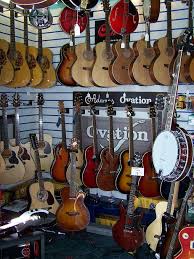
There are several types of acoustic guitars. The most common are the Dreadnought (6 string and 12 string), Classical and Parlor guitars. Each guitar type is designed to accommodate different musical styles. Pictured below are each of these guitar types. Click on the guitar for an in depth look at each one.
Guitar Types: Dreadnought Style Acoustic Guitar
While the dreadnought appears in many variations, this is the guitar that comes to mind whe guitar that comes to mind when most people think "guitar." Sometimes called a western guitar, the Dreadnought is a big instrument with a full sound and a lot of bass. Ideally, dreadnoughts are loud guitars designed to accompany singers or fit into a wide range of musical idioms. For the average player, this is the right guitar.
Different styles of dreadnought guitars include the standard dreadnought constructed of a full range of guitar tone woods from common ones like mahogany and spruce, to woods that are rather exotic like Brazilian rosewood, lacewood or jacaranda. Some guitars don't use wood at all. Instead, they are constructed of composite materials like carbon fiber. Using different materials in the construction of a guitar will contribute dramatically to the sound of the instrument.
Guitar Types: 12 String Dreadnought
The 12 string guitar is similar in construction and styling to the six string guitar. Although it has 12 strings rather than the usual six, the strings work in pairs tuned to the same notes; the first two pairs are tuned to exactly the same pitch while rest are tuned to the same notes one octave apart. This means that, although the 12 string has a fuller, richer timbre, the notes and chord shapes are the same as the standard six string. The additional string tension makes this guitar somewhat less than ideal for beginners. It's a great strumming guitar, but note bending is nearly impossible.
Guitar Types: Cutaway Dreadnought
Another style of dreadnother style of dreadnaught guitar has a cutaway to allow access to the highest register. The cutaway's effect on the guitar's sound is a subject for debate but, the reality is that, if you want to play those frets, you have to be able to reach them. The assumption is that there is a loss of bass response due to the decrease in internal volume. Again, a well made guitar will sound great anyway.
Guitar Types: Parlor Style Acoustic Guitar
The term "parlor guitar" dates back to the days before recorded music where entertainment was conducted live and often in the parlors of those who were lucky enough to have them. Today, the term describes a size and style of guitar. Parlor guitars have smaller bodies than dreadnaughts and often are smaller than even classical guitars. Contrary to popular assumption, their reduced size isn't intended to accommodate smaller players but, rather tler players but, rather to provide for a more even frequency response. In other words, bass, treble and all of the frequencies in between are the same volume. In an acoustically near perfect environment like a "parlor" or concert hall, this even frequency response is a must if the music isn't to be overwhelmed with bass.
Often (in fact, usually), the neck of a parlor guitar is wider than that of a dreadnaught. Parlor guitars are often the choice of fingerstyle players. The wider neck better accommodates this style of player giving him/her more room to get individual fingers between the strings.
Anyone looking for a guitar would be well served to consider a good parlor style guitar. The mid frequencies of these guitars are punchy and pleasing making these instruments a good dhoice for all but the classical or flamenco player.
Guitar Types: Classical Guitar (Nylon String Guitar)
Classical guitars are characterized by the use of nylon (in the old days, cat gut) strings. Typically, these instruments have a wide neck and a very flat fingerboard. Some "old school" instructors feel that this is the only guitar a beginning guitarists should consider as the lighter string tension and greater string gauge are easy on the fingers. (These days, even inexpensive instruments can be extremely well made making them easy to play. So, buy a guitar that is appropriate for the style of music you wish to play.) Classical guitars are best suited for classical music so, it's best to stick to steel strings for most popular musical styles. Of course, if you like the sound, go for it. They are wonderful instruments.
Guitar Types: Jumbo Acoustic Guitar
Jumbo Guitars are designed to be loud and full of bass. It's basically similar in function and usage to the dreadnaught. They're great guitars if well made. In some situations, the mid frequencies get lost, overpowered by the bass. Be aware of this if you are shopping for one and listen objectively in different sized rooms.
Types of Acoustic Guitars ©19