Search lyrics, chords, tabs

Showing posts with label Acoustic guitar. Show all posts

Tuesday, 28 December 2010

Parts of Guitar


Parts of Guitar


Acoustic Guitar
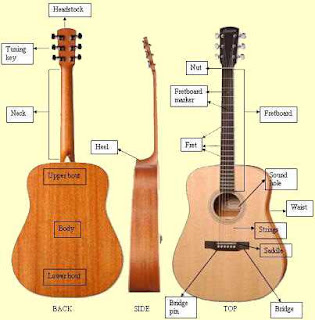
Some common parts of an acoustic guitar includes: undefined
  • Head Stock - The headstock is located at the end of the guitar neck furthest from the body. It is fitted with tuning keys that adjust the tension of the strings, which in turn affects the pitch. Traditional tuner layout is "3+3" in which each side of the headstock has three tuners. Many guitars feature other layouts as well, including six-in-line tuners or even "4+2".
  • Nut - The nut is a small strip of bone, plastic, brass, graphite, stainless steel, or other medium-hard material, at the joint where the headstock meets the fretboard. Its grooves guide the strings onto the fretboard, giving consistent lateral string placement. It is one of the endpoints of the strings' vibrating length. It must be accurately cut, or it can contribute to tuning problems due to string slippage.
  • Tuning Keys - These keys are used to adjust the tension of the strings. Basically every stringed instrument requires a proper adjustment of all the strings. This adjustment of strings is known as TUNING. You need to tune the guitar before playing. The standard tuning used for the guitar is E-B-G-D-A-E (from string 1 to 6).
  • Frets - Frets are metal strips embedded along the fretboard and located at exact points that divide the scale length in accordance with a specific mathematical formula. Pressing a string against a fret determines the strings' vibrating length and therefore its resultant pitch. The pitch of each consecutive fret is defined at a half-step interval on the chromatic scale. Standard classical guitars have 19 frets and electric guitars between 21 to 24 frets.
  • Truss Rod - The truss rod is a metal rod that runs along the inside of the neck. It is used to correct changes to the neck's curvature caused by the neck timbers aging, changes in humidity or to compensate for changes in the tension of strings. The tension of the rod and neck assembly is adjusted by a hex nut or an allen-key bolt on the rod, usually located either at the headstock, sometimes under a cover, or just inside the body of the guitar underneath the fretboard and accessible through the sound hole.
  • Inlays - Inlays are visual elements set into the exterior surface of a guitar. The typical locations for inlay are on the fretboard, headstock, and on acoustic guitars around the soundhole, known as the rosette. Inlays range from simple plastic dots on the fretboard to intricate works of art covering the entire exterior surface of a guitar.
  • Neck - A guitar's frets, fretboard, tuners, headstock, and truss rod, all attached to a long wooden extension, collectively constitute its neck. The wood used to make the fretboard will usually differ from the wood in the rest of the neck. The bending stress on the neck is considerable, particularly when heavier gauge strings are used, and the ability of the neck to resist bending is important to the guitar's ability to hold a constant pitch during tuning or when strings are fretted. The rigidity of the neck with respect to the body of the guitar is one determinant of a good instrument versus a poor one.
  • Neck Joint (Heel) - This is the point at which the neck is either bolted or glued to the body of the guitar. Almost all acoustic guitars have glued necks or set necks, while electric guitars are constructed using both types.
  • Strings - Modern guitar strings are manufactured in either metal or organo-carbon material. Instruments utilizing "steel" strings may have strings made of alloys incorporating steel, nickel or phosphor bronze. Classical and flamenco instruments have historically used gut strings but these have been superseded by nylon and carbon-fibre materials. Bass strings for both instruments are wound rather than monofilament.
  • Body - The body of an acoustic guitar has a sound hole through which sound is projected. The sound hole is usually a round hole in the top of the guitar under the strings. Air inside the body vibrates as the guitar top and body is vibrated by the strings, and the response of the air cavity at different frequencies is characterized, like the rest of the guitar body, by a number of resonance modes at which it responds more strongly. Most electric guitar bodies are made of wood and include a plastic pick guard. Boards wide enough to use as a solid body are very expensive due to the worldwide depletion of hardwood stock since the 70's, so the wood is rarely one solid piece. Most bodies are made of two pieces of wood with some of them including a seam running down the centre line of the body.
  • Bridge - The main purpose of the bridge on an acoustic guitar is to transfer the vibration from the strings to the soundboard, which vibrates the air inside of the guitar, thereby amplifying the sound produced by the strings. On both electric and acoustic guitars, the bridge holds the strings in place on the body. There are many varied bridge designs. There may be some mechanism for raising or lowering the bridge to adjust the distance between the strings and the fretboard (action), and/or fine-tuning the intonation of the instrument. 

Electric Guitar
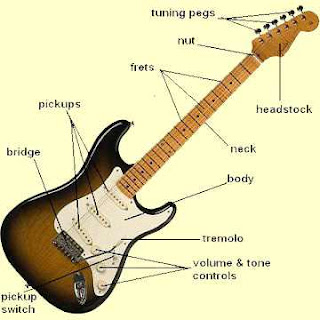
Apart from the parts discussed above the electric guitar have these additional components: undefined
  • Pickups - Pickups are transducers attached to a guitar that detect (or "pick up") string vibrations and convert the mechanical energy of the string into electrical energy. The resultant electrical signal can then be electronically amplified. The most common type of pickup is electromagnetic in design. These contain magnets that are tightly wrapped in a coil, or coils, of copper wire. Such pickups are usually placed right underneath the guitar strings. Electromagnetic pickups work on the same principles and in a similar manner to an electrical generator. The vibration of the strings causes a small voltage to be created in the coils surrounding the magnets, this signal voltage is later amplified.
  • Electronics - On guitars that have them, these components and the wires that connect them allow the player to control some aspects of the sound like volume or tone. These at their simplest consist of passive components such as potentiometers and capacitors, but may also include specialized integrated circuits or other active components requiring batteries for power, for pre-amplification and signal processing, or even for assistance in tuning. In many cases the electronics have some sort of shielding to prevent pickup of external interference and noise.
  • Vibrato Arm - The Vibrato (pitch bend) unit found on many electric guitars has also had slang terms applied to it, such as "tremolo bar (or arm)", "sissy bar", "wang bar", "slam handle", "whammy handle", and "whammy bar". It is used for a pitch raising effect.
Share |

Thursday, 3 June 2010

guitar_anatomy.jpg
The guitar is one technology that was designed to have a positive impact on society. It was meant to produce appealing sounds and bring joy to people. On the flip side it has contributed to capitalism through encouraging competition through records sales and concerts. Not to say that is a bad thing, but it does happen. It has changed the way people incorporate music into there lives. Maybe it was the record companies that really encouraged capitalism. They were definitely encouraged by this instrument in the age of Rock and Roll.

It has had an impact on be personally for the past few months. The tenant living upstairs from me plays and screeches day and night. He has immediate satisfaction from playing, which I think was probably one of the ideas behind the invention, I believe his roommates do too. Why else would they put up with it? He does not realize the effects is has on others in the area. Many nights I do not get a good nights rest because of this. The sound travels clearly into my bedroom. This causes me to be tired and crabby the next day, potentially affecting others I interact with. I also do not do my work as effectively as I may have if well rested. What if I had the potential to do something for the world and did not achieve it because I missed an opportunity to learn something pivotal this semester. The world could suffer because I didn’t learn because I was exhausted from the guy upstairs pounding out tunes on an instrument design to bring pleasure to the world. Or maybe I should just go have a talk with him.

Share |


Guitar Pictures


(1) Acoustic Guitars and Classical Guitars


Acoustic Bass Guitar

Acoustic Bass Guitar


12 String Classic Guitar

12 String Classical Guitar


Classic Guitar

Classical Guitarist
(could also be playing Latin or flamenco music)


(2) Electric Guitars


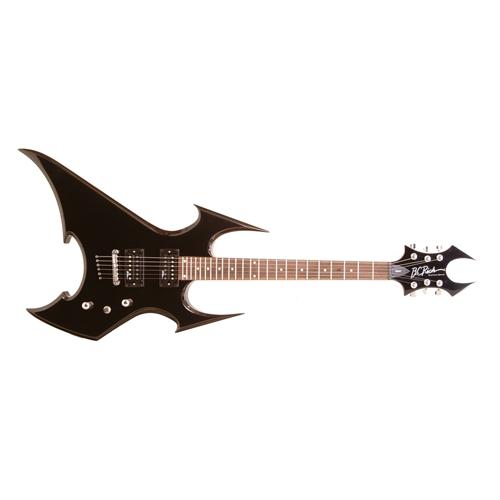
Electric Guitar

Electric Guitar


4  String Bass Guitar

Man Playing 5 String Bass Guitar


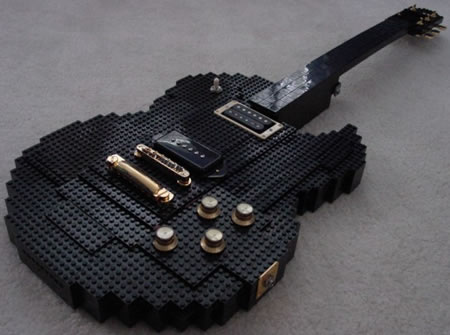
LEGO Guitar

LEGO Guitar

Check out this cool guitar made out of black plastic LEGO building bricks.

The creation includes all of the functioning parts, such as pick-ups and bridge. The only thing missing is a set of strings, and you’ll be ready to start jamming.

Visit geekasaurus.com for a larger photo of the LEGO Guitar.

(1) Classical Guitar Pictures

Picture of Classical Guitar

Man playing a classical guitar


(2) Acoustic Guitar Pictures

Picture of Acoustic Guitar

Man playing an acoustic guitar


Mariachi Player with Acoustic Guitar

Wandering mariachi (street musician) player in Mexico


(3) Electric Guitar Pictures

Picture of Electric Guitar

Man playing rock and roll music on an electric guitar


Share |

Picture of Guitar


Share |

Tuning of Guitar

Self-tuning guitars

Main article: Musical tuning

Self-tuning guitars are computerized guitars programmed to tune themselves. The Gibson Robot Guitar, released in 2007, is often mistaken as the first of this kind, but was preceded by the Transperformance system by at least 20 years. Gibson has also released a second, self-tuning model called the Dark Fire.[citation needed]

Tuning

Main article: Guitar tuning

The guitar is a transposing instrument. Its pitch sounds one octave lower than it is notated on a score.

A variety of different tunings may be used. The most common tuning, known as "Standard Tuning," has the strings tuned from a low E, to a high E, traversing a two octave range – EADGBE. When all strings are played open the resulting chord is an Em7/add11.

The pitches are as follows:

String

Scientific pitch

Helmholtz pitch

Interval from middle C

Frequency

first

E4

e'

major third above

329.63 Hz

second

B3

b

minor second below

246.94 Hz

third

G3

g

perfect fourth below

196.00 Hz

fourth

D3

d

minor seventh below

146.83 Hz

fifth

A2

A

minor tenth below

110 Hz

sixth

E2

E

minor thirteenth below

82.41 Hz

The table below shows a pitch's name found over the six strings of a guitar in standard tuning, from the nut (zero), to the twelfth fret.

0

1

2

3

4

5

6

7

8

9

10

11

12

E

F

F

G

A

A

B

B

C

C

D

E

E

B

C

C

D

E

E

F

F

G

A

A

B

B

G

A

A

B

B

C

C

D

E

E

F

F

G

D

E

E

F

F

G

A

A

B

B

C

C

D

A

B

B

C

C

D

E

E

F

F

G

A

A

E

F

F

G

A

A

B

B

C

C

D

E

E

A guitar using this tuning can tune to itself using the fact, with a single exception, that the 5th fret on one string is the same note as the next open string; that is, a 5th-fret note on the sixth string is the same note as the open fifth string. The exception is the interval between the second and third strings, in which the 4th-fret note on the third string is equivalent to the open second string.

Standard tuning has evolved to provide a good compromise between simple fingering for many chords and the ability to play common scales with minimal left hand movement. Uniquely, the guitar's tuning allows for repeatable patterns which also facilitates the ease in which common scales can be played.[22] There are also a variety of commonly used alternate tunings – most of which are open tunings that create entire chord voicings without fretting any strings. Many open tunings, where all of the strings are tuned to a similar note or chord, are popular for slide guitar playing. Alternate tunings are used for two main reasons: the ease of playing and the variation in tone that can be achieved.

Many guitarists use a long established, centuries-old tuning variation where the lowest string is 'dropped' down a whole tone. Known as Drop-D (or dropped D) tuning it is, from low to high, DADGBE. This allows for open string tonic and dominant basses in the keys of D and D minor. It also enables simple fifths (powerchords) to be more easily played. Eddie Van Halen sometimes uses a device known as a 'D Tuna,' the patent for which he owns. It is a small lever, attached to the fine tuner of the 6th string on a Floyd Rose tremolo, which allows him to easily drop that string's tuning to a D. Many contemporary rock bands retune all strings by several semi-tones, making, for example, Drop-C or Drop-B tunings, However this terminology is inconsistent with that of "drop-D" as "drop-D" refers to dropping a single string to the named pitch. Often these new tunings are also simply referred to as the "Standard" of the note in question e.g. – "D Standard" (DGcfad').

Some guitarists tune in straight fourths, avoiding the major third between the third and second strings. While this makes playing major and minor triads slightly more difficult, it facilitated playing chords with more complicated extended structures[citation needed]. One proponent of the straight fourth tuning (EADGCF) is Stanley Jordan.

As with all stringed instruments a large number of scordatura are possible on the guitar. A common form of scordatura involves tuning the 3rd string to F to mimic the standard tuning of the lute, especially when playing renaissance repertoire originally written for the lute.

Share |

Neck joint or 'Heel'

Neck joint or 'Heel'

See also: Set-in neck, Bolt-on neck, and Neck-through
This is the point at which the neck is either bolted or glued to the body of the guitar. Almost all acoustic steel-string guitars, with the primary exception of Taylors, have glued (otherwise known as set) necks, while electric guitars are constructed using both types. Most classical guitars have a neck and headblock carved from one piece of wood, known as a "Spanish heel."

Commonly used set neck joints include mortise and tenon joints (such as those used by CF Martin & Co. guitars), dovetail joints (also used by CF Martin on the D28 and similar models) and Spanish heel neck joints which are named after the shoe they resemble and commonly found in classical guitars. All three types offer stability. Bolt-on necks, though they are historically associated with cheaper instruments, do offer greater flexibility in the guitar's set-up, and allow easier access for neck joint maintenance and repairs.

Another type of neck, only available for solid body electric guitars, is the neck-through-body construction. These are designed so that everything from the machine heads down to the bridge are located on the same piece of wood. The sides (also known as wings) of the guitar are then glued to this central piece. Some luthiers prefer this method of construction as they claim it allows better sustain of each note. Some instruments may not have a neck joint at all, having the neck and sides built as one piece and the body built around it.
Share |

Guitar Neck

Guitar Neck
 
Picture of guitar neck

 
picture 
of guitar 
neck with notes


picture of guitar neck


picture of guitar neck

Main article: Neck (music)

A guitar's frets, fretboard, tuners, headstock, and truss rod, all attached to a long wooden extension, collectively constitute its neck. The wood used to make the fretboard will usually differ from the wood in the rest of the neck. The bending stress on the neck is considerable, particularly when heavier gauge strings are used (see Tuning), and the ability of the neck to resist bending (see Truss rod) is important to the guitar's ability to hold a constant pitch during tuning or when strings are fretted. The rigidity of the neck with respect to the body of the guitar is one determinant of a good instrument versus a poor one. The shape of the neck can also vary, from a gentle "C" curve to a more pronounced "V" curve. There are many different types of neck profiles available, giving the guitarist many options. Some aspects to consider in a guitar neck may be the overall width of the fingerboard, scale (distance between the frets), the neck wood, the type of neck construction (for example, the neck may be glued in or bolted on), and the shape (profile) of the back of the neck. Other type of material used to make guitar necks are graphite (Steinberger guitars), aluminium (Kramer Guitars, Travis Bean and Veleno guitars), or carbon fiber (Modulus Guitars and ThreeGuitars).

Double neck electric guitars have two necks, allowing the musician to quickly switch between guitar sounds.
Share |

Frets, Fretboard, Fingerboard

Fretboard


Main article: Fingerboard

Also called the fingerboard, the fretboard is a piece of wood embedded with metal frets that comprises the top of the neck. It is flat on classical guitars and slightly curved crosswise on acoustic and electric guitars. The curvature of the fretboard is measured by the fretboard radius, which is the radius of a hypothetical circle of which the fretboard's surface constitutes a segment. The smaller the fretboard radius, the more noticeably curved the fretboard is. Most modern guitars feature a 12" neck radius, while older guitars from the 1960s and 1970s usually feature a 6-8" neck radius. Pinching a string against the fretboard effectively shortens the vibrating length of the string, producing a higher pitch. Fretboards are most commonly made of rosewood, ebony, maple, and sometimes manufactured or composite materials such as HPL or resin. See below on section "Neck" for the importance of the length of the fretboard in connection to other dimensions of the guitar.
undefined
Frets


Main article: Fret
undefined
Frets are metal strips (usually nickel alloy or stainless steel) embedded along the fretboard and located at exact points that divide the scale length in accordance with a specific mathematical formula. Pressing a string against a fret determines the strings' vibrating length and therefore its resultant pitch. The pitch of each consecutive fret is defined at a half-step interval on the chromatic scale. Standard classical guitars have 19 frets and electric guitars between 21 to 24 frets (though Caparison Guitars issue guitars with as many as 27 frets.[19])


Frets are laid out to a mathematical ratio that results in equal tempered division of the octave. The ratio of the spacing of two consecutive frets is the twelfth root of two. The twelfth fret divides the scale length in two exact halves and the 24th fret position divides the scale length in half yet again. Every twelve frets represents one octave. In practice, luthiers determine fret positions using the constant 17.817, which is derived from the twelfth root of two (21/12). The scale length divided by this value yields the distance from the nut to the first fret. That distance is subtracted from the scale length and the result is divided in two sections by the constant to yield the distance from the first fret to the second fret. Positions for the remainder of the frets are calculated in like manner.[20] Actual fret spacing does not use this exact value; the fret spacing on the fretboard was also done by trial and error (testing) method over the ages.

There are several different fret gauges, which can be fitted according to player preference. Among these are "jumbo" frets, which have much thicker gauge, allowing for use of a slight vibrato technique from pushing the string down harder and softer. "Scalloped" fretboards, where the wood of the fretboard itself is "scooped out" between the frets allows a dramatic vibrato effect. Fine frets, much flatter, allow a very low string-action but require other conditions such as curvature of the neck to be well maintained in order to prevent buzz.

On steel-string guitars, frets are eventually bound to wear down; when this happens, frets can be replaced or, to a certain extent, leveled, polished, recrowned, or reshaped as required.


Truss rod

Main article: Truss rod

The truss rod is a metal rod that runs along the inside of the neck. It is used to correct changes to the neck's curvature caused by the neck timbers aging, changes in humidity or to compensate for changes in the tension of strings. The tension of the rod and neck assembly is adjusted by a hex nut or an allen-key bolt on the rod, usually located either at the headstock, sometimes under a cover, or just inside the body of the guitar underneath the fretboard and accessible through the sound hole. Some truss rods can only be accessed by removing the neck. The truss rod counteracts the immense amount of tension the strings place on the neck, bringing the neck back to a straighter position. Turning the truss rod clockwise will tighten it, counteracting the tension of the strings and straightening the neck or creating a backward bow. Turning the truss rod counter-clockwise will loosen it, allowing string tension to act on the neck and creating a forward bow. Adjusting the truss rod affects the intonation of a guitar as well as the height of the strings from the fingerboard, called the action. Some truss rod systems, called "double action" truss systems, tighten both ways, allowing the neck to be pushed both forward and backward (standard truss rods can only be released to a point beyond which the neck will no longer be compressed and pulled backward).

Classical guitars do not require truss rods as their nylon strings exert a lower tensile force with lesser potential to cause structural problems. However their necks are often reinforced with a strip of harder wood, such as an ebony strip running down the back of a cedar neck. There is no tension adjustment on this form of reinforcement.
Share |